Tell us who you are and what you do.
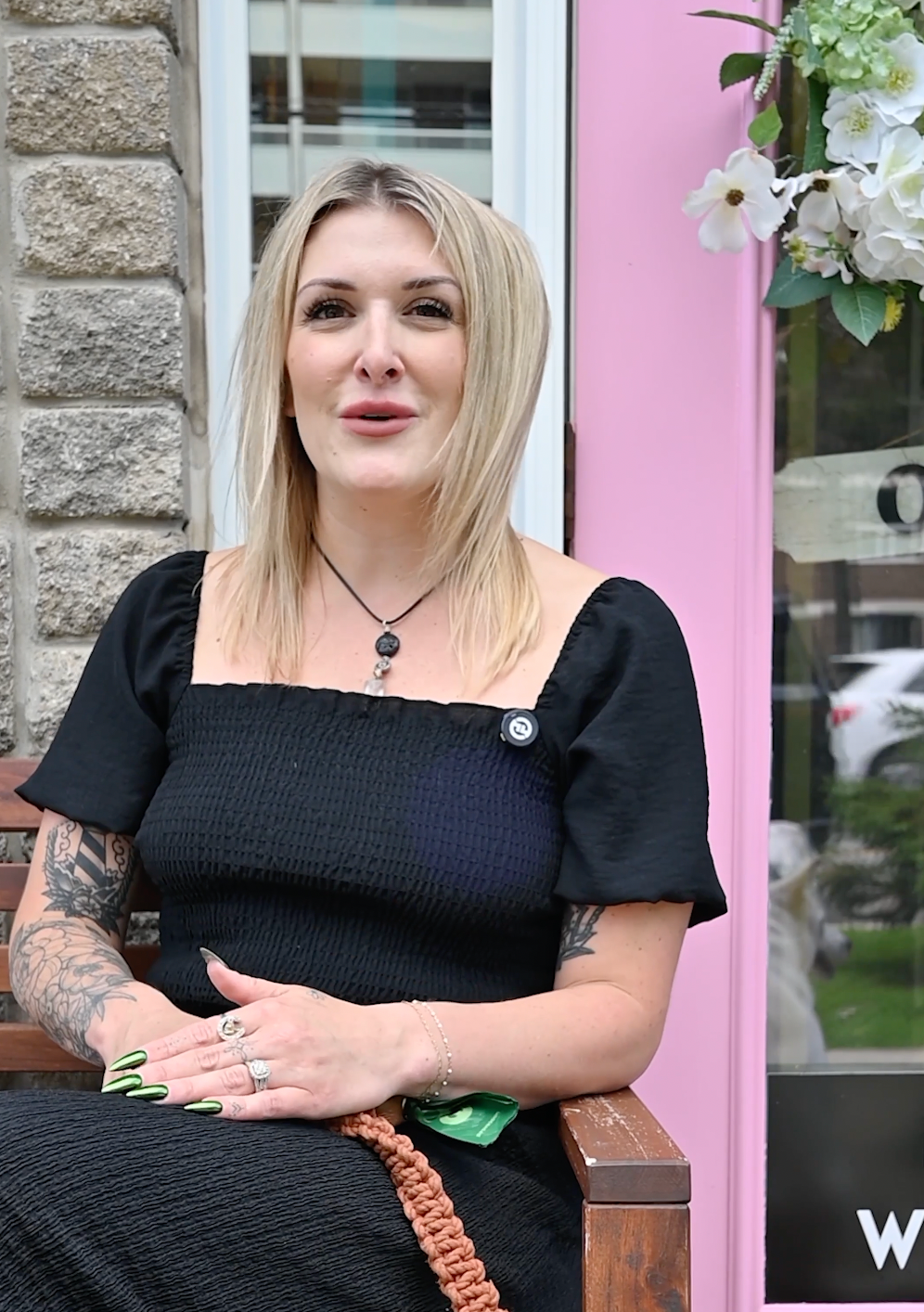
My name is Sarah Ernest and I’m the founder and CEO of Ernest for Good. I help leaders and social profits energize their fundraising and brighten their brands, unapologetically.
What was the inspiration? What got you into this in the first place?
Over 20 years in philanthropy and communications work across North America, raising over $30 million. And then deciding to take a leap of faith, bet on myself, and go into entrepreneurship. Really, to help people do good better: raise funds, create more impact in their community. But doing it the way I’ve done it throughout my career, which often went against a lot of the, we’ll say, fundraising rules.
What about the way that you do it breaks the mold?
The way I support leaders and organizations in advancing philanthropy and impact does go a bit against outdated and arbitrary rules. Oftentimes charities are encouraged to play small, accept the crumbs, be very quiet, and try to appease and be everything to everyone.
And in the context of branding, to differentiate in terms of who you are and what you have to offer, you have to stand out. You have to be bold. You have to be unapologetic in what you do. That’s where Earnest for Good steps in. We really help these organizations understand what their secret sauce is, and then how to double down on that to stand out in what is often a crowded market.
Oftentimes charities are encouraged to play small, accept the crumbs, be very quiet, and try to appease and be everything to everyone.
Out of all the lessons you’ve learned in philanthropy, what are the main things you bring to the table that are a little different? And how does that translate into actual campaigns?
At Ernest for Good we’re really focused on being in it with you. I think the difference is that a lot of consultants may not have had that nitty, on-the-ground, roll-up-your-sleeves, get-the-job-done experience. With my 20-plus years in the industry, I truly get it. I know what you’re going through. I’ve been there, I’ve done that. So I always call myself a partner in your mission. Your best friend and your biggest cheerleader in advancing impact.
The way we do it is very based on vulnerability. Trust-based philanthropy is embedded in all of our approaches. Oftentimes in the context of charitable giving there’s this notion that the donor is always right, and it can be a very top-down approach.
From a trust-based philanthropy approach, it’s really honoring that the charity, the folks on the ground doing this work, who are working with vulnerable populations, they know what people need to be well and to thrive. It’s honoring and trusting that, and working directly with them. So it’s about educating and redirecting donors, having difficult conversations, and really working with a trust-based philanthropy approach and mindset. An abundance mindset, which is often not the case in a lot of charitable organizations. We’re rooted in scarcity. A lot of times we’re begging.
Who are you working with right now?
I work with a number of organizations across southwestern Ontario, and even as far as some work for folks in Uganda, South Sudan and Haiti. Earnest for Good is currently working on campaigns with charity partners like YWCA Niagara Region, Help Heal Humanity, and the TEED Therapeutic Writing Centre. Hey Black Girl. Project Agape. There are so many good things that we’re doing and exciting projects that we’re working on.
What has you most excited about the future for Earnest for Good? Where do you see it going in the next three to five years?
The grand vision of Ernest for Good: more impact. Deeper impact.
My goal, my hope, is to really transform the philanthropy landscape, to deploy more fractional fundraising opportunities. Where charities and organizations might not have the capacity internally to advance and execute on a philanthropy strategy, we can step in and actually help them do that, and raise the funds for sustainability, to help diversify their income, diversify their revenue, and really stand out.
Also education and resources. One of my hopes is to meet more charities and leaders where they’re at by making the information and the expertise that I have, that the folks I work with have, more accessible. So more workshops, master classes, accelerator programs, things like that. And that’ll help facilitate all the other stuff that comes.
That’s the beautiful thing about education. If you educate people, you don’t have to do as much selling, because they know the value of it. It has a snowball effect.
Absolutely. My hope is to make myself redundant. My goal is to empower you, and to work with you and your team, to raise the funds that you need to thrive, so that you don’t need me anymore. I shouldn’t exist a couple of years after working with me. That’s the hope.
My hope is to make myself redundant. I shouldn’t exist a couple of years after working with me.
What brought you here? What do you love about it?
I love Burlington. I’m from Nova Scotia, from the East Coast, and for me community is about how you feel. It’s how you feel when you’re in community, how you’re welcomed. Since coming to Burlington, and it’ll be three years this fall, I’ve just been totally welcomed with open arms.
Being from the East Coast, it’s all about helping your neighbour, taking care of one another. As a single woman, I feel very safe here. I think the community genuinely cares. The folks in leadership, the city itself, they care about the city and it shows. It’s beautiful. It’s safe. It’s clean. And I love the waterfront. I’m always walking.
That’s why I wanted to live here, essentially: the waterfront. To be able to walk my dogs, go down Lakeshore, bop around the local shops, go from coffee to cocktails to lunch, whatever. It’s so beautiful. I don’t think I’m leaving anytime soon. For the first time in a while, I want to kind of stay put.
You’ve bounced around to a lot of different places. Does that inform why Burlington feels special?
I’ve lived a hundred lives, I always say. I’ve moved around quite a bit. I’m very nomadic in that I go where there are opportunities for my work, my career. But since coming to Burlington, I haven’t really had that itch to leave and go on to the next thing. Building my business here, having community here. And I have so many of my friends and community in Hamilton as well, so to be that close.
Halton Region in and of itself: a lot of the charities I work with are within this catchment area. I’ve lived from California to Nova Scotia, to Hamilton. And to be in Burlington, this is where I feel most at home. Most at peace.
What advice would you have for young people, especially young women entrepreneurs, who want to get started?
Advice I have if you’re thinking about entrepreneurship, if you’re a young person, and even if you’re not a young person, anyone, because it can happen at any phase and stage of life: don’t ask for permission. Just go for it.
No one is ever going to feel fully ready. Nobody is ever going to tap you on the shoulder and say, “Hey, I think it’s time that you go off and do your own thing.” No. You’re the only person with the vision that you have, the mind that you have, the approach that you have. So just trust it. Go for it.
I think leading with your values, to me, is everything. Your character, your integrity, how you show up. Be kind. Be courteous. These are East Coast values that are instilled in me as a rural Nova Scotian. Small town values. I carry them with me in everything that I do. The continuity of that, and staying true to yourself, but being kind.
And being curious. I think that’s one of the biggest ones. Nothing is linear. We think we’re going to do this, and really we end up here. If we just approach life and the world with curiosity, there’s so much beauty that can come out of that that you don’t even know about yet.
So I would say: be the audacity.
Nobody is ever going to tap you on the shoulder and say, “I think it’s time that you go off and do your own thing.” Be the audacity.